

Recommendations on Substack: Think Beyond Subscriber Numbers

Recently I’ve had a couple of clients who have noticed something about their subscribers after gaining many subscribers through recommendations:
“My subscriber numbers went up dramatically after I started getting recommendations, but my open rates didn’t increase in proportion. Now I just have a really low open rate.”
At first glance, it seems like recommendations didn’t really work, but in reality, I think they worked exactly as they were designed to.
Recommendations brought new people to the publication. They increased the subscriber count and expanded the audience. What they didn’t guarantee was that those new subscribers would become engaged readers.
What Recommendations Are Designed to Do
Recommendations are one of the features that makes Substack different from many other publishing platforms. Instead of relying entirely on search engines or social media algorithms, writers introduce their readers to other writers they believe are worth following.
It’s a wonderful idea that we can create relationships on Substack that will benefit ourselves, and other writers, “a rising tide lifts all boats” as the saying goes. If I recommend another publication, I’m essentially telling my readers, “I think you’ll enjoy this person’s work.” Some of those readers will subscribe simply because they trust my judgement.
In that sense, recommendations are less like advertising and more like introductions. They create an opportunity for someone to discover your work who may never have found you otherwise, which is incredibly valuable.
But introductions and relationships are not the same thing.
A recommendation can encourage someone to subscribe. It can’t make them open your next article, leave thoughtful comments, become a paid subscriber, or spend the next several years reading everything you write.
Creating relationships and engaged subscribers is still your responsibility.
The Difference Between Growth and Alignment
One of the things I’ve noticed while working with clients is that we sometimes assume all subscriber growth is equally valuable.
It’s easy to understand why.
Subscriber numbers are visible; they increase immediately after someone recommends you, and seeing that number rise really feels like progress. On the other hand, engagement takes time to develop, and it isn’t reflected in the same exciting upward graph.
If your goal is simply to increase the number beside your subscriber count, recommendations can be remarkably effective, but if your goal is to build an engaged community of readers who open your emails, reply to your articles, attend your Lives, upgrade to paid subscriptions, and become part of your long-term audience, then subscriber numbers tell only part of the story.
You Don’t Control Who Recommends You
There’s another aspect of recommendations that I don’t think we talk about often enough.
You don’t control who recommends your publication.
Someone may genuinely love your work and enthusiastically recommend it to their subscribers. That’s generous, and it’s one of the things I enjoy most about the culture of Substack.
But their audience may not be your audience.
A publication about investing might recommend a publication about entrepreneurship. A writer focused on memoir might recommend someone writing about creativity. Those audiences probably overlap beautifully.
On the other hand, someone with a very different readership may also recommend you simply because they admire your writing. Their recommendation isn’t wrong, but it may introduce your work to readers who were never looking for what you offer.
It’s important to remember that recommendations does not equal audience alignment and engagement, often recommendations can result in a larger subscriber list without a corresponding increase in engagement.
Cultivating the Right Recommendations
The strongest recommendations I’ve seen rarely begin with a request to recommend one another — a “recommendation swap”. They grow naturally through conversations, thoughtful comments, shared interests, guest posts, collaborations, and genuine participation in the Substack community.
Over time, writers begin to understand one another’s work and, just as importantly, one another’s audiences. When that happens, recommendations become particularly valuable, because they’re based on genuine audience overlap rather than convenience.
When another writer says, “I think my readers would appreciate your work,” they’re usually right because they’ve taken the time to understand both sides of that relationship.
Those are the recommendations that tend to bring readers who stay and participate in your Substack publication.
Building the Audience You Actually Want
One of the questions I ask myself before recommending another publication is whether I would genuinely personally encourage my subscribers to subscribe to this writer.
If the answer is yes, then it’s probably a recommendation worth making. If the answer is no, I don’t think growing someone else’s numbers—or my own—is reason enough.
Recommendations are one of the most generous features on Substack, and I hope they remain a central part of the platform. They help writers discover one another, encourage collaboration, and create opportunities that simply don’t exist on many other platforms.
But I also think it’s worth remembering what they’re designed to do. Recommendations are introductions. Everything that happens after that depends on the publication you’ve built.
A recommendation may convince someone to subscribe, but it is your Hero Post, your welcome email, your archive, your point of view, and the quality of your writing that convinces them to stay and engage.
When we focus less on collecting subscribers and more on building an audience that genuinely connects with our work, recommendations become something much more meaningful than a numbers growth strategy.
Practical Implementation
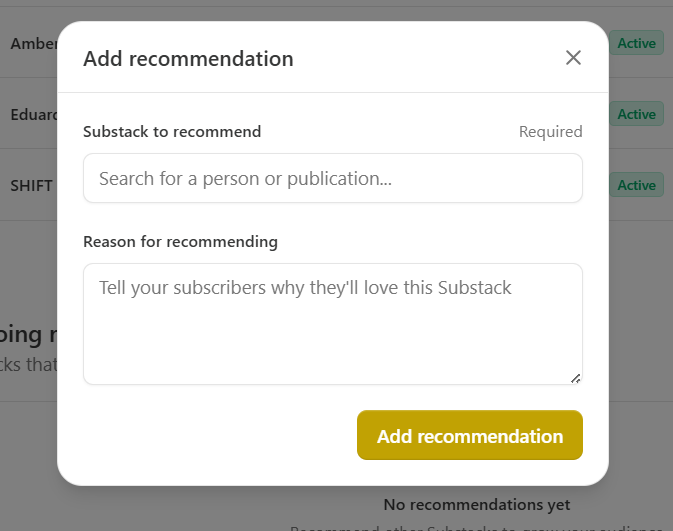
Where do you find the Recommendations? Go to your Dashboard, scroll down the left side menu and click on “recommendations”. Then choose “Add Recommendation”

And finally search for the publication you want to recommend. Remember that you can only recommend publications you actually subscribe to.
If you’d like more ongoing support, paid membership gives you access to Tuesday Post-It Notes & Chat Q&A, monthly Zoom help, included workshops, and 15% off small-group cohorts.
It’s designed for writers who want reliable guidance as they build on Substack without jumping straight into one-to-one coaching.
This is super helpful Adrienne. Thank you. One question I have is this: if I follow your instructions below and recommend a publication, will it automatically send an email to my subscribers telling them I'm recommended that publication? I really DON'T want that to happen. I thinking about overhauling those publications I recommend and I don't want a big email blast going to my subscribers. Can you let me know and/or let me know if there's a way for that NOT to be the case?
Thank you so much in advance.
شكرا على هذه النصيحة الثمينة